 If Something Happens Tomorrow . . . Would Your District Know What to Do?
As technology leaders, we often hope and pray that the unthinkable never happens. But imagine receiving that critical phone call: systems are locked, confidential data may be exposed, and printers are filled with ransom notices.
by Shawntee Cowan, Chief Technology Officer, Mansfield ISD
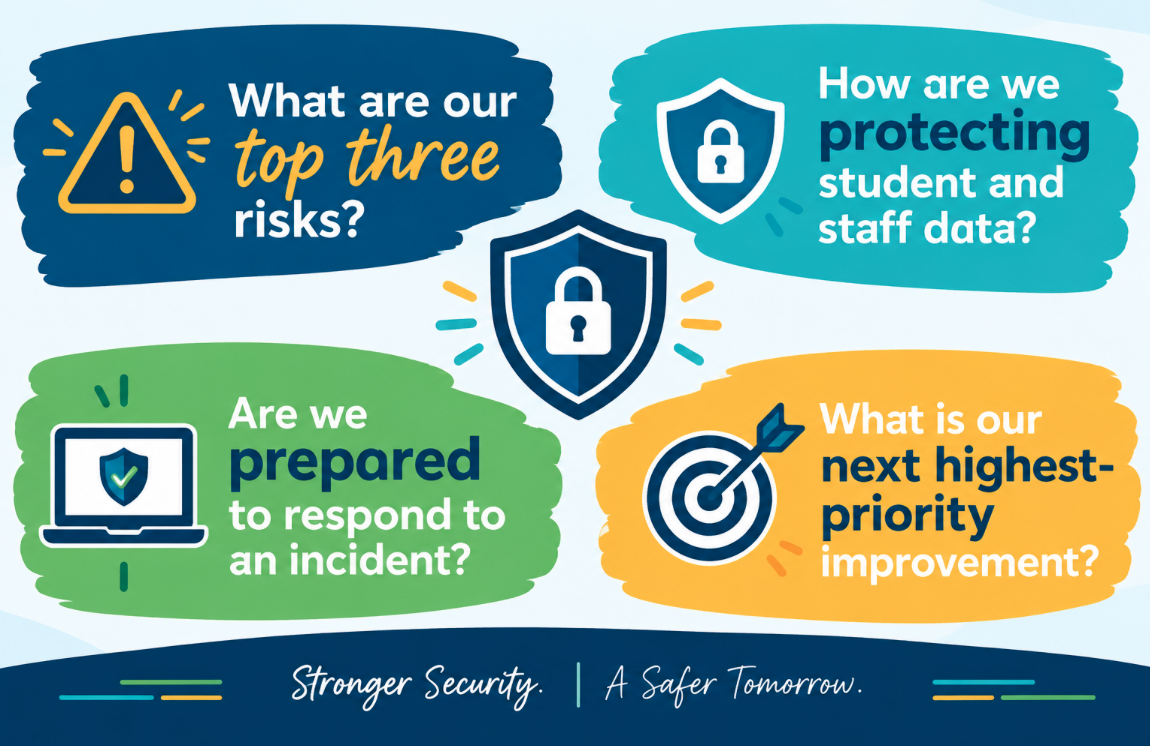
What would you do? Would everyone in your district know what to do? How would you notify families? Would you have phone numbers readily available for required reporting, law enforcement, and cyber insurance? Would you have an incident response partner on retainer?
Sometimes an incident like this reveals the many cracks in districts’ incident response plans. We are not alone. No matter the size, demographics, or location of your Texas district, resources are available.
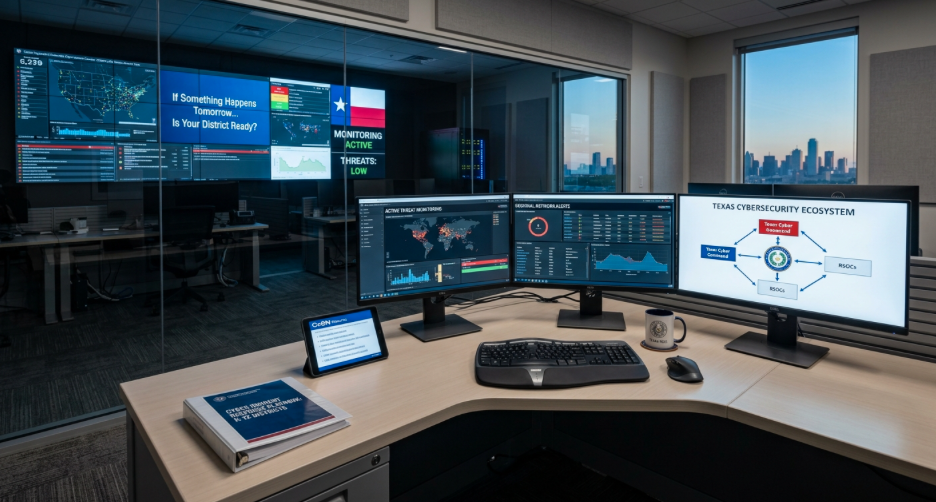 Texas Resources: Texas Cyber Command & RSOCs
Texas Cyber Command (TXCC)
Did you know Texas school districts do not have to build their cybersecurity posture in silos? Under Texas law, Texas Cyber Command (TXCC) provides cybersecurity resources for our state, including information for K-12 districts. TXCC’s strategy is built around five mission pillars: Prevent, Secure, Protect, Defend, and Educate. They send just-in-time notifications with actionable threat intelligence and offer solutions to address identified threats. By providing leadership, direction, and tools to strengthen statewide cybersecurity defenses, TXCC is certainly worth partnering with.
Regional Security Operations Centers (RSOC)
In addition to TXCC, Regional Security Operations Centers (RSOC), in collaboration with Texas DIR (Department of Information Resources), is an established cybersecurity program that offers cyber-related solutions to local and state entities. These centers provide cybersecurity services and operational support at no cost. Funded by the state of Texas and as a part of Senate Bill 475, services offered are typically supported by a hybrid of professional staff and trained students.
What Benefits Do RSOCs Provide?
*24/7 Monitoring & Alerts
*100% State-Funded
*Policy & Planning Assistance
*Immediate Incident Response
*Educational Services, Guidance & Training
*Works Alongside Existing MSSP or IT Staff to Fill Gaps
*Provides Cybersecurity-Related Products/Systems (From Minimal to Integrated Infrastructure)
Visit RSOCs’ websites to learn more about their offerings. To receive service as a K-12 school district, reach out to an applicable university hosting the RSOC to execute an interlocal agreement.
An actual cybersecurity incident is not the time to start planning to strengthen and secure your network. Do not wait for an incident to partner with organizations that can proactively help secure your environment. Review your protocols often and be sure that you and your staff are prepared to act quickly if needed.
Essential Resources for K-12 Technology Leaders
|
TEXAS CYBER COMMAND |
|
|
News and Intelligence |
|
|
Reporting Cybersecurity Incident |
|
|
State Certified Cybersecurity Training Programs |
|
|
Incident Response Team Redbook Template |
|
|
AVAILABLE TEXAS RSOCs |
|
|
Angelo State University (West Texas) |
ASU RSOC Website | rsoc@angelo.edu |
|
UT Austin (Central/Statewide) |
UTA RSOC Website | rsoc@utexas.edu |
|
UT Rio Grande Valley (South Texas) |
|
|
COSN: CYBERSECURITY RESPONSE |
|
|
COSN Member Benefits |
Cybersecurity Response Website Benefits: Ransomware Member Brief Cyber Insurance Guidelines Incident After Action Review IR Training Game |
References:
Angelo State University. (n.d.). Regional Security Operations Center (RSOC). Kay Bailey Hutchison Institute for Education and Workforce Readiness. Retrieved September 30, 2026, from https://www.angelo.edu/community/kay-bailey-hutchison-institute/operations/regional-security-operations-center/
Texas Department of Information Resources. (2024, January). An overview of RSOCs in Texas [White paper]. https://dir.texas.gov/sites/default/files/2024-01/An%20Overview%20of%20RSOCs%20in%20Texas%20Jan%202024.pdf
Texas Department of Information Resources. (2025, September). Whole of state in the Lone Star State: The Texas Regional Security Operations Centers 2.0 (NASCIO State IT Recognition Awards Nomination). National Association of State Chief Information Officers.https://www.nascio.org/wp-content/uploads/2025/09/TX_Cybersecurity.pdf
University of Texas at Austin. (n.d.). RSOC services. UT Regional Security Operations Center. Retrieved September 30, 2026, from https://rsoc.utexas.edu/services
University of Texas Rio Grande Valley. (n.d.). Regional Security Operations Center. Retrieved September 30, 2026, from https://www.rsoc.utrgv.edu/
Gemini. (2026). * Texas Regional Security Operations Center (RSOC) monitor desk displaying cybersecurity preparedness resources* [AI-generated image]. Google.
Texas School Districts Do Not Have to Tackle Cybersecurity Alone
Cybersecurity can feel like an enormous responsibility for a school district technology team—but Texas districts do not have to tackle it alone.
by Kimberly Bowlin, Assistant Director Technology Acquisitions, Cy-Fair ISD
The Texas Education Agency’s K-12 Cybersecurity Initiative connects school systems with state-funded cybersecurity services, technical assistance, assessments, and tools designed specifically for Texas K-12 environments. Launched in 2023 in response to rising ransomware and other malicious cyber activity targeting school systems, the initiative focuses on practical solutions to help districts strengthen their defenses and reduce the risk of major cyber incidents.
And that support is continuing. For the FY26/FY27 biennium (September 2025–August 2027), the Texas Legislature approved an additional $42 million for the initiative, with remaining FY24/FY25 funds also carried forward.
What Is Available in 2026–2027?
TEA identifies several areas of continued or expanded support for FY26/FY27, including managed Endpoint Detection and Response (EDR), Texas Cybersecurity Framework (TCF) assessments, technical assistance through Education Service Centers (ESCs), and additional security controls intended to strengthen cybersecurity maturity across the state.
TEA also identifies several new FY26/FY27 initiatives that are available to all school systems at no cost:
- Cloud Email Security — Provided in partnership with the University of Texas Regional Security Operations Center (UT-RSOC).
- DIR-Certified Security Awareness Training and Phishing Simulations — Provided in collaboration with the Technology Alliance for Statewide Initiatives (TASI).
- Microsoft 365 and Google Workspace Hardening Guides — Developed by TASI to help districts implement more secure configuration practices.
- Software Deployment Solution for EDR and Other Applications — Provided through TASI to assist districts with deploying EDR agents and other software. The TEA information lists this service as available beginning October 15, 2026, with districts directed to their regional ESC for the pre-registration interest survey.
Are Resources Limited by District Size or Location?
For many of the new FY26/FY27 services, no. TEA specifically states that the new initiatives listed above are available to all school systems at no cost. Cybersecurity technical assistance through ESCs is also available to all school systems. In contrast, TEA-funded third-party cybersecurity assessments are available to all school systems on a first-come, first-served basis.
There is an important exception: TEA-funded EDR subscriptions have enrollment-based limitations and priorities.TEA states that EDR is prioritized for small and midsize school systems and that it intends to focus on small and rural school systems. Distribution is limited to school systems with a total enrollment of 50,000 students or fewer. Eligible systems receive between 30 licenses and a number equal to 30% of student enrollment, whichever is larger. TEA recommends initially focusing those licenses on high-risk and high-impact devices, including servers and central-office staff devices.
So, while rural districts receive priority for some assistance, particularly EDR, the initiative is not exclusively a rural-district program. Many resources are available statewide regardless of whether a district is rural, suburban, or urban.
Your ESC Can Help You Navigate the Options
Regional Education Service Centers are an important part of the initiative. FY26/FY27 funding includes continued support for ESCs to provide technical assistance to school systems implementing the K-12 Cybersecurity Initiative.
Some services also require districts to complete agreements or onboarding before they can participate. For example, EDR and TCF assessments require onboarding through the Department of Information Resources Shared Technology Services program, including execution of an interlocal contract. Cloud Email Security through UT-RSOC similarly requires an Interlocal Cooperation Agreement before submitting the TEA service request.
The key message for technology leaders is simple: you do not have to determine all of this on your own. State-funded services, regional expertise, and implementation support are available—and your district may have access to resources your technology team has not yet tapped.
Take the Next Step
Talk with your ESC or technology team about which resources are available to your district. Ask what your district is already using through the Texas K-12 Cybersecurity Initiative, what additional FY26/FY27 services you may qualify for, and what onboarding steps are needed to take advantage of them.
Cybersecurity may be a shared challenge across Texas schools, but it is also one we can address with shared resources, expertise, and support.
SB820 requires school districts to:
* Designate a security coordinator
* Adopt a cybersecurity policy
* Report any breach of student personally identifiable data to TEA
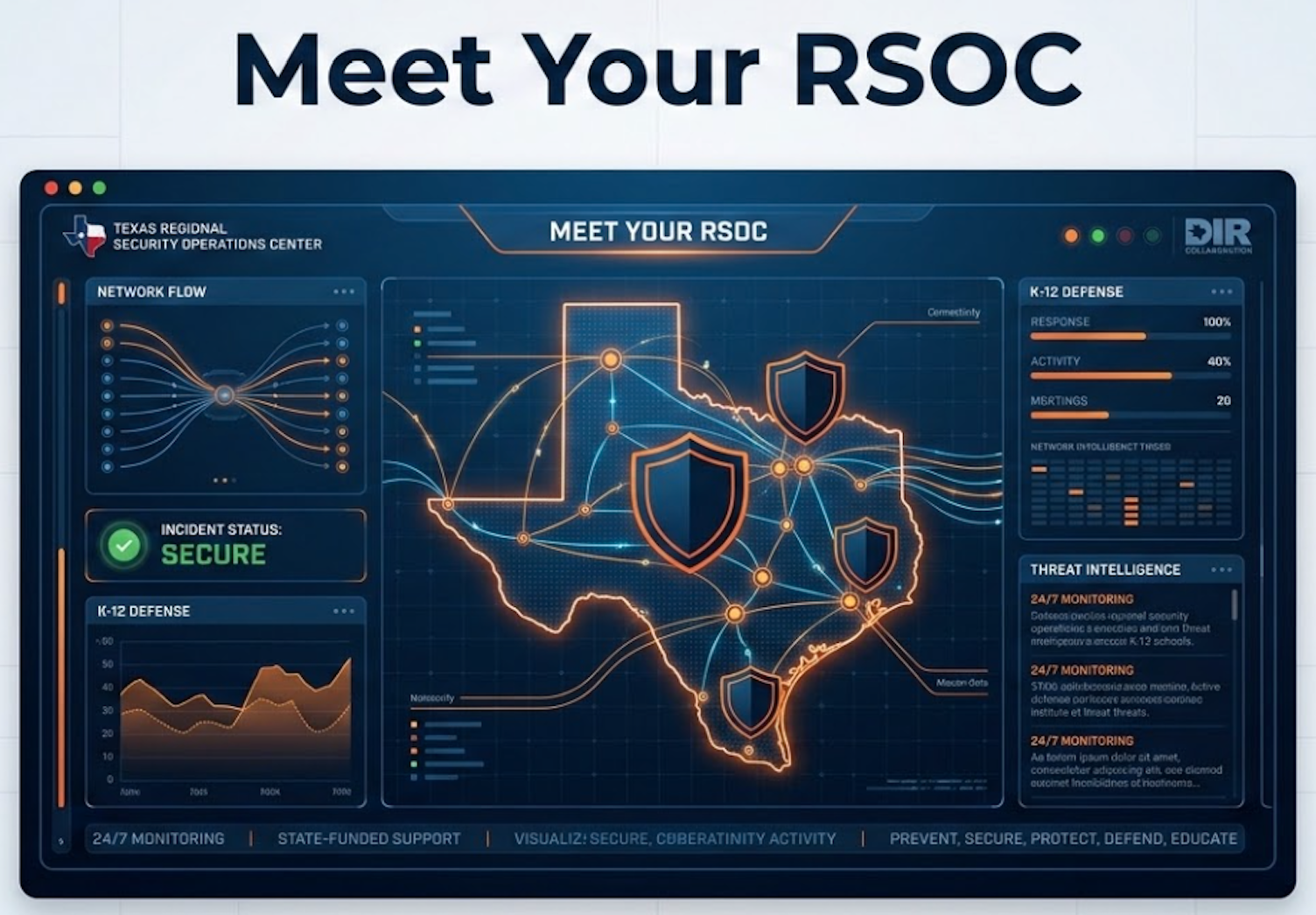
🛡️ Meet Your Regional Security Operations Center (RSOC)!
Did you know Texas Independent School Districts (ISDs) can access enterprise-grade cybersecurity monitoring, threat intelligence, and incident response support—100% state-funded and at zero cost to local school systems?
Established under Senate Bill 475 in collaboration with the Texas Department of Information Resources (DIR), RSOCs pair professional cybersecurity staff with university talent to help secure local and state entities.
Key Services Provided:
*24/7 Security Monitoring & Alert Filtering (SIEM/SOAR)
*Endpoint Detection & Response (EDR) & Passive Network Monitoring
*Vulnerability Scanning & Dark Web Credential Monitoring
*Immediate Incident Response & Tabletop Readiness Exercises
*Email Security & Phishing Simulations
*NEW - Endpoint Patching & Software Deployment
Available RSOC Locations & Contacts:
*Angelo State University (West Texas): rsoc@angelo.edu
*UT Austin (Central/Statewide): rsoc@utexas.edu
*UT Rio Grande Valley (South Texas): Visit www.rsoc.utrgv.edu
Don't wait for a cybersecurity incident to start planning. Reach out to your regional university RSOC today to execute an interlocal agreement and proactively strengthen your district's security posture!

Cybersecurity Shift (HB150 & HB1500): Moves most state cybersecurity responsibilities from DIR to the new Texas Cyber Command.
Training: Requires local government officials to complete annual cybersecurity training. Cyber Command will certify at least five programs.
Read all the details here.
Cybersecurity Policy:
A district is required to have a cybersecurity policy in order to:
- secure district cyberinfrastructure against cyber attacks and other cybersecurity incidents.
- determine cybersecurity risk and implement mitigation planning.
The policy may not conflict with the information security standards for institutions of higher education adopted by the Department of Information Resources under Chapters 2054 and 2059, Government Code.
Statewide Cybersecurity Awareness Training
HB1118 (87R) amends some of the cybersecurity training requirements for state and local governments. Here is a link to the bill text. Organizations are encouraged to confer with their legal counsel concerning specific requirements, or if there are additional questions.
What is a Certified Cybersecurity Training Program?
Texas Government Code 2054.519 State Certified Cybersecurity Training Programs requires requires DIR, in consultation with the Texas Cybersecurity Council, to certify at least five cybersecurity training programs for state and local government employees and Section 2054.5191 requires state and local government employees and officials to complete a certified training program. The statute also requires state government contractors to complete a certified training program.
Cybersecurity Coordinator:
The superintendent of each school district must designate someone to be the cybersecurity coordinator for the district to serve as a liaison between the district and the agency in cybersecurity matters.
The cybersecurity coordinator is required to:
- report any breach of the district’s information systems to the agency.
- provide notice to a parent or guardian of a breach that involves a student’s PIA.
TASB Cybersecurity Resources
School Cybersecurity: Getting Started (pdf)
School Cybersecurity: Texas Requirements (pdf)
School Cybersecurity: Security Breach Notification and Response (pdf)
These and other articles can be found on TASB's Technology page in the TASB Legal eSource Library, which is constantly updated and increased.